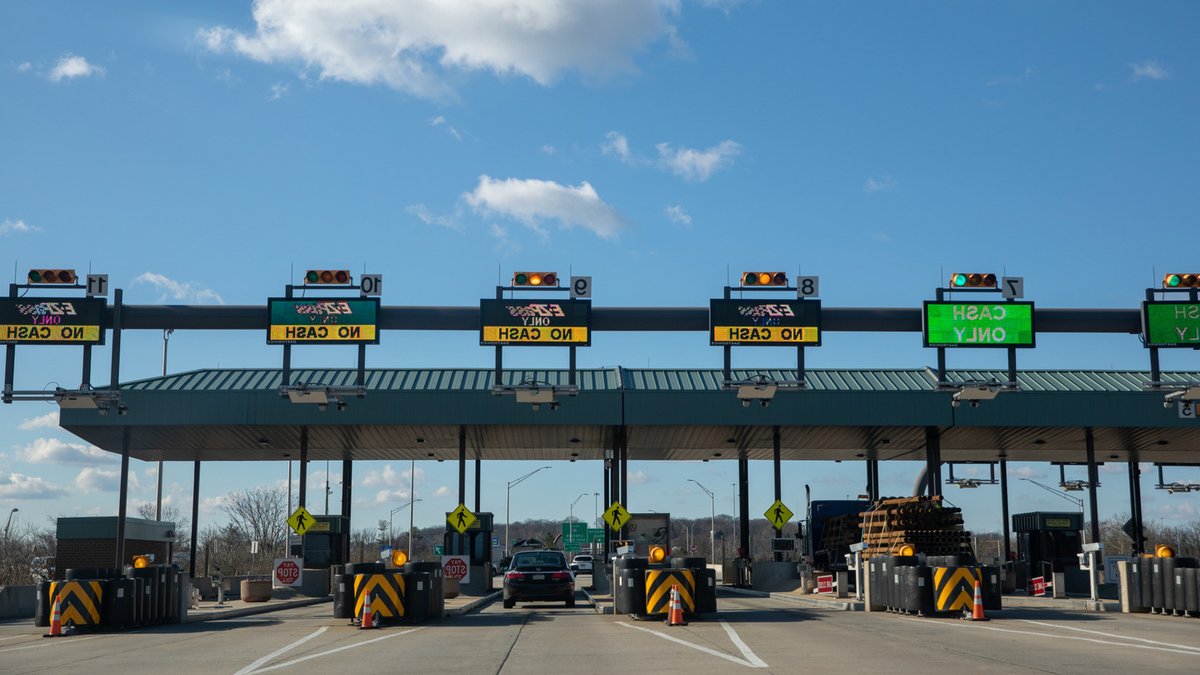
The Pennsylvania Turnpike, America’s oldest active toll road, will remove all its toll booths by 2027 and switch to open-road tolling. The transition, already underway, will eliminate physical payment stations along the 360-mile route connecting Harrisburg to Pittsburgh and the state borders with New Jersey and Ohio. Originally opened in 1940, the turnpike began as a 160-mile stretch crossing the Appalachian Mountains, with later expansions in the 1950s extending it to its current length. Its design even served as a blueprint for the broader Interstate Highway System.
The change follows a 16-year planning process, with the first feasibility study conducted in 2010. Officials initially deemed the shift impossible due to the lack of fiber-optic infrastructure. The COVID-19 pandemic accelerated the shift in 2020, when toll booths went contactless and relied solely on electronic payments. By 2025, the turnpike began testing open-road tolling on select sections, with gantries installed to monitor vehicle entry and exit points for distance-based tolling calculations.
Open-road tolling uses overhead gantries to photograph vehicles as they pass, reading EZPass transponders or calculating tolls based on distance traveled. Sensors in the pavement detect axle counts to distinguish commercial trucks, while antennas on the gantries capture vehicle images for verification. The system eliminates the need to slow down at toll plazas, reducing traffic congestion and improving safety. Some of the original toll booths remain in place along the route, though one from the 1940-era has been preserved at the State Museum of Pennsylvania as part of a historical exhibit.
Removing toll booths will cost $134 million for infrastructure upgrades in Western Pennsylvania alone. However, the Pennsylvania Turnpike Authority expects annual savings of $25 million once fully operational. The transition will also eliminate the need for staffed booths, further cutting operational expenses. The upfront costs will be offset over time by reduced maintenance and labor requirements.
Safety is a key driver behind the change. A 2024 crash on Interstate 80—where an SUV abruptly swerved into a toll lane—led the National Transportation Safety Board to recommend eliminating low-speed tolling lanes in favor of fully electronic systems. The crash killed two passengers and injured others, highlighting the risks of traditional toll plazas where drivers must slow down and merge. The board’s findings reinforced the need for high-speed electronic tolling to prevent such incidents.
Open-road tolling is not unique to Pennsylvania. New York City’s bridges and tunnels removed booths in 2022, while Florida’s Turnpike and Illinois Tollway made the switch in 2021 and 2024, respectively. The trend reflects broader industry shifts toward efficiency and reduced congestion. Many other toll roads across the country are in the midst of similar transitions, phasing out booths in favor of automated systems.


