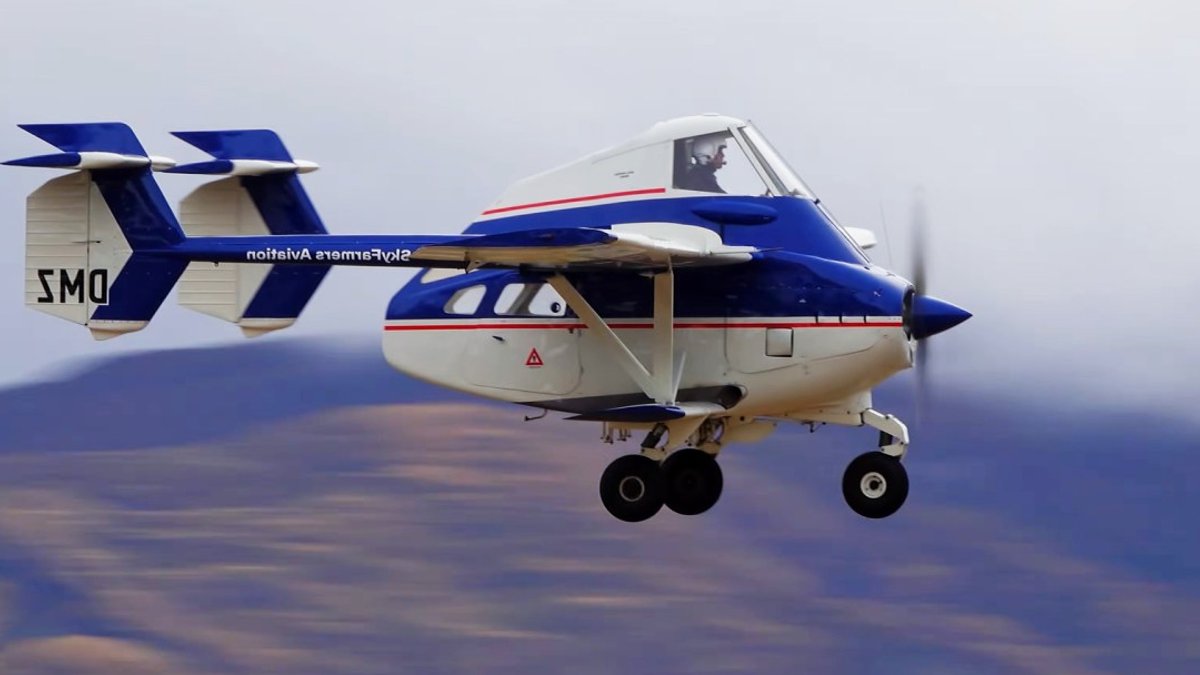
The Transavia PL-12 Airtruk stands out as one of the most unusual aircraft ever built, with twin tails and a body shaped like a flying barrel. Developed in the 1950s by Italian designer Luigi Pellarini, the plane was built for agricultural work, specifically spreading fertilizer and seeds. It first flew in 1966 and remained in production until 1988, with a total of 138 units produced and exported globally.
Design Features and Utility
The Airtruk’s design prioritizes function over aesthetics. Its high cockpit sits above a 300-horsepower engine, giving the pilot excellent visibility while keeping the fuselage short. This layout creates a wide lower hopper for chemicals, allowing a truck to back up to the rear without cutting the engine. The twin tails also keep the control surfaces out of the prop wash, improving stability during takeoff and landing.
Wings are attached in a sesquiplane configuration, meaning the lower wing is shorter than the upper one. These wings help the plane maintain airspeeds as low as 45 to 50 mph. At just under 1,700 pounds, the aircraft could take off in as little as 200 to 300 feet of runway, a critical feature for operating in tight agricultural environments.
Read Also: Dirt Racing Documentary Offers Raw, Authentic Motorsports Thrill
Agricultural models included a second passenger seat behind the pilot and a system to drop 2,000 pounds of payload in three seconds if the pilot needed to gain altitude quickly. Cargo versions replaced the chemical hopper with a lower passenger deck for four people and were marketed as rural air ambulances.
From a pilot’s perspective, the Airtruk handles differently than most planes. One operator described it as not stalling in the conventional sense, but rather mushing along in a nose-high attitude with little tendency to roll or buck. This stability allows for precise control when flying low and making abrupt inputs.
Development History
Pellarini initially designed the plane for an Australian company seeking to enter the crop-dusting market. His first attempt, the PL-7, featured a rear-mounted cockpit and was rejected. He then developed the PL-11, built with parts from a World War II T-6 Texan, but early prototypes crashed. By 1964, Bennett abandoned the whole thing.
Read Also: Home Depot bundles include free batteries Black Friday
An Australian firm, Transavia Corporation, acquired the project. In 1966 the newly-refined Transavia PL-12 Airtruk finally arrived, becoming a weird point of national pride for Australia as the only domestically-built light aircraft at the time. The production run lasted 22 years, with only minor updates to the engine and aerodynamics.
Legacy and Decline
Unfortunately, rising competition and a recession in the 1980s caused Transavia to hit the skids, and an ill-fated attempt to build a military version of the Airtruk wasn’t enough to keep it going. The Airtruk ended its run in 1988. Ultimately, the Airtruk is a shining example of function over form. It looks the way it does because it was designed by a slightly-unhinged Italian who wanted to maximize its ability to do a very specific job, and there’s something undeniably appealing about machines that successfully carry that ethos.


