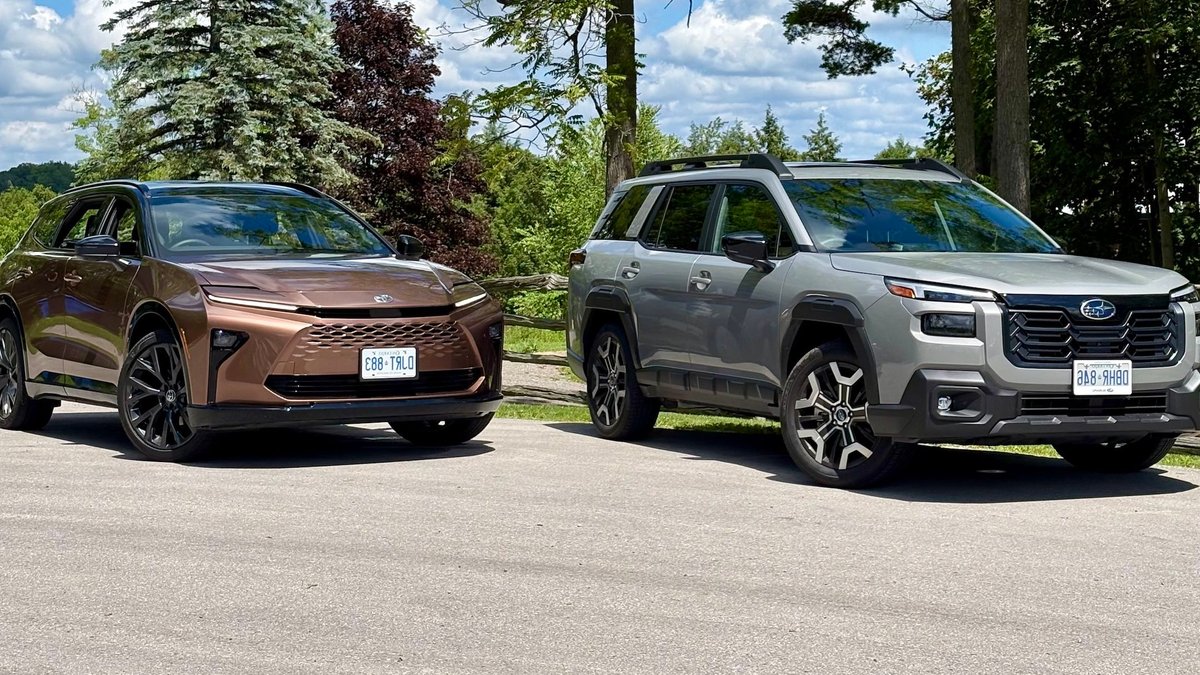
Midsize SUVs dominate the Canadian market for families, offering a blend of comfort, handling, and reasonable fuel economy. Two models recently compared offer starkly different approaches to this formula. The 2026 Subaru Outback and the Toyota Crown Signia represent opposing design philosophies, yet both aim to serve active lifestyles. The new Subaru has abandoned its traditional wagon profile for a more rugged, truck-like appearance. In contrast, the Toyota Crown Signia evolved from the Venza, retaining a lifted sedan aesthetic that prioritizes urban sophistication.
Dimensions and Interior Space
The two vehicles share nearly identical width and wheelbase measurements, but the Crown Signia is slightly longer while the Outback is taller. This height advantage gives the Subaru a significant ground clearance benefit. It also translates into greater cargo capacity, with the Outback offering 980 litres of trunk space compared to 702 litres in the Toyota. When the rear seats are folded flat, the Outback expands to 2,280 litres, outpacing the Crown Signia’s 1,872 litres.
Despite the Outback’s taller stance, the Crown Signia provides ample passenger space in both rows. However, the Subaru edges out the Toyota in headroom, legroom, hip room, and shoulder room on paper. While the Crown Signia offers a sophisticated, “lounge-like” environment, the Outback’s two-tone interior design feels more premium to the testers. Both top-trim vehicles feature hard buttons for climate and seat controls, a practical choice for drivers who prefer physical switches over touchscreens.
Related: Google Introduces Motion Dots to Reduce Car Sickness
While the Outback boasts superior cargo numbers, the Crown Signia’s cabin design gives it a visual edge. The Toyota’s sleek lines and modern dashboard layout create a more upscale feel than the boxy interior of the Subaru. This aesthetic difference is particularly noticeable when comparing the two vehicles side-by-side in a driveway.
Powertrain and Efficiency
Performance in these two vehicles is defined by their powertrains. The Outback uses a turbocharged 2.4L boxer four-cylinder engine producing 260 horsepower and 277 lb-ft of torque. The power delivery is smooth, though the testers noted a slightly jumpy throttle response that requires a softer foot. The Subaru’s all-wheel-drive system distributes power evenly across the wheels, providing confident handling.
The Toyota Crown Signia relies on a 2.5L four-cylinder paired with a hybrid transaxle and a nickel metal hydride battery. The system generates 240 horsepower but suffers from a coarse gas engine. Under heavy acceleration, the engine makes a discordant noise that detracts from the otherwise quiet cabin. Despite this mechanical roughness, the hybrid system is efficient. The Crown Signia promises fuel consumption of 6.0/6.3/6.2 L/100 km, while the Outback is rated at 11.0/8.3/9.7 L/100 km. In real-world testing, the Toyota delivered 6.4 L/100 km, while the Subaru showed 11.1 L/100 km.
The Subaru’s powertrain is slicker and stronger, but it demands more from the fuel tank. The Toyota’s hybrid efficiency offers a distinct advantage for drivers concerned about rising gas prices, allowing for fewer stops at the pump. The difference in fuel economy becomes the deciding factor for many shoppers in the current economic climate.
Related: 2027 Jeep Wrangler Smoky Mountain celebrates off-road event
Handling and All-Wheel Drive Capabilities
Both vehicles offer quiet cabins, but their all-wheel-drive systems serve different purposes. The Subaru Outback, with its higher ride height and rugged styling, is built for challenging conditions. The testers drove the Outback in Sedona, Arizona, through biblical downpours on red clay trails. The vehicle handled the slipppery, overflowing terrain with ease, demonstrating a capability that the Crown Signia lacks.
The Crown Signia’s hybrid system is reactive and effective for daily suburban driving. It handles dry pavement and light inclement weather well, but it is not designed for serious off-road use. The Outback’s AWD system is a more robust tool for northern winters, offering peace of mind when the weather turns bad.
Ultimately, the choice depends on the driver’s priorities. The Outback is a versatile, spacious wagon-like SUV that excels in utility and winter performance. The Crown Signia is a stylish, efficient hybrid that prioritizes city driving and fuel economy. For those who value the Toyota’s efficiency and design, the Crown Signia represents the better value. For those who need a rugged, capable vehicle for any season, the Outback remains the superior choice.


