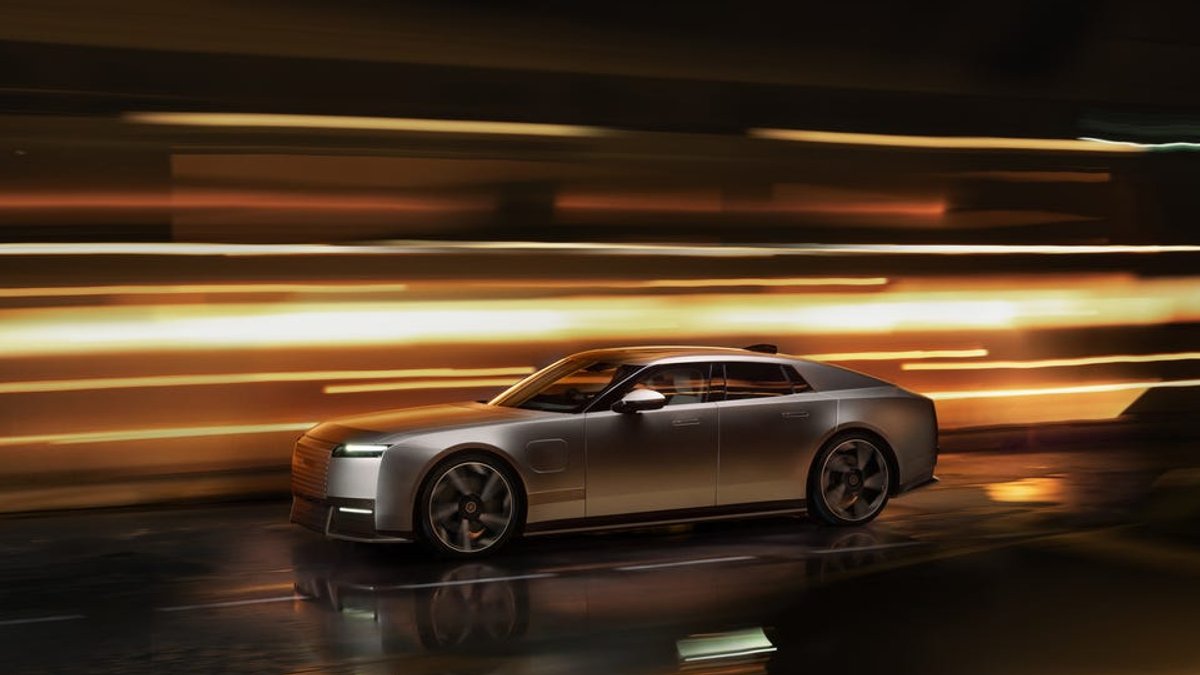
The Jaguar Type 01 has arrived with a design so divisive that even its name—Type Zero One—will likely divide opinions. The electric luxury sedan, unveiled in New York, redefines Jaguar’s visual language with bold styling that rejects traditional norms. Up close, its proportions feel more refined than early images suggested, though its sheer size remains impossible to ignore. At 206.1 inches long, it is just 2.7 inches shorter than the Mercedes-Benz S-Class, yet its 4-inch-lower roof and aggressive sheet metal create a presence that feels intentional rather than excessive.
Its most controversial feature is the glassless fastback, a design that removes the rear window entirely in favor of horizontal slats and a black plastic bezel concealing the lights. The front abandons a traditional grille for active shutters managing airflow, while slim, high-mounted headlights emphasize the car’s width. Jaguar’s design director, Andrew Wheel, says the Type 01 is “the truest expression of Jaguar, in the context of today.”
A journalist who attended Jaguar’s pre-reveal event noted the Type 01 achieves a deliberate balance between memorability and controversy. The “impossible panel” at the C-pillar, formed in six stamping steps using a 2,500-ton press, adds visual drama, though the available color options remain limited. Buyers can choose from what Jaguar calls a “German rainbow” of hues, with only two standout finishes: satin-finished French Ultramarine and London Red. Classic Jaguar colors like British Racing Green, navy blues, or even orange are absent, reinforcing the car’s modern, exclusive identity.
Practicality vs. Luxury: A Cramped Cabin
The Type 01’s practicality remains unproven, as the car won’t reach customers until mid-2027. Early impressions suggest compromises in the cabin. Despite its imposing exterior, rear legroom is tight—even a 6-foot-3-inch journalist found both front and back seats uncomfortably cramped. The 2+2 seating feels more symbolic than functional, and ingress requires an awkward combination of twisting and ducking to avoid the door frame.
The interior, however, embodies modern minimalism. A 24-inch digital instrument cluster sits behind an oval steering wheel, while a 7-inch center screen defines the dashboard’s central spine, subtly reinforcing the car’s elongated proportions. Materials include vegan leather and seats with minimal cut lines, giving the cabin the polished look of designer furniture. Yet compromises remain: the cargo floor is hard plastic with ridges, a detail that clashes with the car’s premium positioning.
Electric Architecture: Jaguar’s Bold Future Platform
Underneath, the Type 01 represents a fresh start. Built on Jaguar’s JEA platform, a dedicated electric architecture, it will underpin two future models. The 120 kWh prismatic battery pack, using nickel-heavy NMC chemistry, delivers 400 miles on the EPA five-cycle test, though Jaguar markets the figure using the stricter WLTP cycle to reflect real-world conditions. Charging capabilities are equally ambitious: an 850-volt system restores 200 miles in 13 minutes, and the battery can split into two 400-volt packs for 250-kW fast charging on Tesla Superchargers via a NACS port in North America.
Read Also: Biden celebrates classic cars at Rhode Island concours
The power output is now confirmed: 1,015 horsepower and 1,007 pound-feet of torque from its tri-motor setup. Jaguar confirms 0-60 mph in the three-second range, with a focus on high-speed acceleration, 0-112 mph in four seconds. This aligns with the brand’s tradition of reserved power.
Controversial Design Choices and Trade-offs
The Type 01’s design choices extend beyond aesthetics to functional trade-offs. The glassless fastback eliminates the rear window, replacing it with slats and a camera-mounted bezel. While this creates a striking visual, it removes direct rear visibility, forcing drivers to rely entirely on the camera display, a potential issue in tight parking or low-visibility conditions. Jaguar acknowledges this limitation but frames it as a deliberate choice to prioritize sculptural impact over practicality, mirroring the E-Type’s own controversial styling from the 1960s.
The interior’s ergonomics further highlight the tension between form and function. Despite the car’s imposing exterior, the cabin’s compact layout, particularly the 2+2 seating, feels like an afterthought. Rear ingress is awkward, requiring sideways twisting and ducking under the door frame. The vestigial rearview mirror, mandated for U.S. compliance, sits awkwardly at the top of the low windshield, suggesting Jaguar nearly removed it entirely before regulatory requirements intervened.
Jaguar has positioned the Type 01 as a clean-sheet design, meaning it shares no underpinnings with existing models, including those from sister brand Land Rover. The JEA platform, a fully electric architecture, will support two future vehicles, signaling Jaguar’s long-term commitment to electrification. This independence from Land Rover’s platforms reinforces Jaguar’s ambition to redefine its identity separately from its corporate sibling.
The dual-charging doors, one per side, emphasize convenience, though the need to align with specific ports for different speeds adds complexity for owners.


