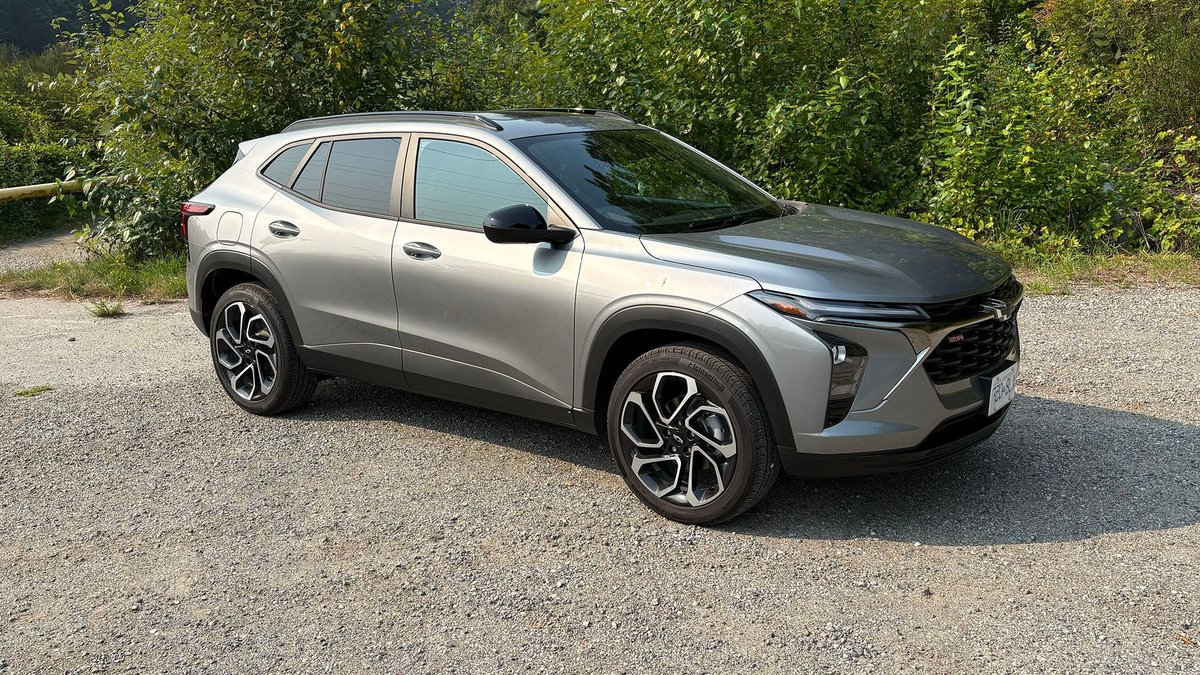
The 2026 Chevrolet Trax RS is a subcompact crossover that provides a great blend of occupant and cargo space along with a spirited driving experience. After spending a week behind the wheel of the Trax RS, which has a base MSRP of $29,998, it’s clear that this crossover is a strong contender in its segment.
General Motors has done an exceptional job with its EV stable, and that’s showing on the sales sheet: the company is the top-selling EV brand in Canada, with sales growth of 33.4% through the first half of 2026. The Trax debuted as a subcompact crossover in 2015 in Canada and remained relatively unchanged until it was discontinued after the 2022 model year.
They introduced the Trax as a subcompact crossover in 2015.
The all-new, larger, much better-looking and -equipped Trax returned as a second-generation model in 2024, with a slightly smaller but turbocharged three-cylinder engine. The real standout feature, however, is the totally redesigned cabin, which punches over its weight for a $30K vehicle.
The new exterior design is far superior to the first-gen model; its longer, lower, and sleek design leans more into a station-wagon vibe than a crossover. The interior borders on sport luxury, with a sport steering wheel, 11-inch infotainment screen, and bright red stitching on the steering wheel, dashboard, and very comfortable sport seats.
The 2026 Trax RS is powered by a peppy turbocharged 1.2-litre three-cylinder engine, which provides a very real fun-to-drive aspect. The larger wheels, shod with low-profile tires, give the crossover a very stable and firm ride, and cornering felt very responsive, aided greatly by somewhat heavy electric power steering.
Related: BMW recalls 800 vehicles in Canada over power loss risk
The standard Stabilitrak system, which provides stability and traction control, gives the Trax a very planted and sure-footed feel. The sport steering wheel also conveys the sense that this is a driver-centric vehicle, and the sight-lines to both the driver display and centre display are excellent, making the operation of the Trax all the better.
One potential drawback is the fact that there is no all-wheel-drive model available, as there was with the first-gen Trax. However, for commuters or urban drivers, front-wheel drive is more than up to the job, particularly with good tires, such as winter tires when the temperatures drop.
The Trax’s combined fuel economy of 8.1 L/100 km is bested by some of its competitors, but it’s not like the Trax’s efficiency is way off that of the competition.
Our test Trax came with a base price of $29,899, and was optioned with the following: sunroof package, three-year Sirius package, engine-block heater, and wheel locks. Throw in a $2,300 destination charge and $699 dealer fee, and the total price is $34,682. For the quality, design, and performance of the Trax, this represents very good value.
In practice, the Trax’s strong points, such as its driving characteristics and great value for money, make it an attractive option for those shopping in the subcompact crossover segment, including electric car tech.
While it may not be perfect, with some drawbacks such as the lack of all-wheel drive and slightly lower fuel economy, the Trax is well worth considering for its overall package.


